Sunday, 28 June 2020

Shōmei Tōmatsu (1930-2012)


Nagoya Smoking Prostitute (1958)


Bottle Melted and Deformed by Atomic Bomb Heat, Radiation, and Fire, Nagasaki, 1961


Untitled, from the series Screen (1969)


Atomic Bomb Damage: Wristwatch Stopped at 11:02, August 9, 1945, Nagasaki, 1961


Untitled, from the series Eros, Tokyo (1969)

Paris, Texas (1984)

The 1984 Wim Wenders film Paris, Texas is truly spectacular. It is exquisitely aesthetic/artistic/experimental yet highly relatable and accessible, slow and subtle yet suspenseful, unreal, sentimental and dramatic yet entirely vernacular and everyday. Completely beautiful.


The exploration of language is fascinating - particularly the need to eradicate language, communication and exchange when one cannot face themselves and what they've done, as a way to escape and continue to survive with the shame of one's actions: refuting and unlearning linguistic faculties as a mode of purification and purification as a survival tactic.


Daidō Moriyama (1938-)


Saturday, 27 June 2020

Late in the Day by Tessa Hadley

It has been a long time since I read a book as exceptional as Late in the Day by Tessa Hadley. 


The novel is so well-observed, following the lives of four friends—two married couples—throughout several decades. The characters are not defined by obvious tropes but are complex, multivalent, and with competing and conflicting motivations that drive their actions. Hadley brilliantly defines characters by what they do and what they choose not to do as well as how they choose to define themselves in contrast or opposition to their friends/spouses or their idea of them.


The book tackles issues around defining oneself through either theory and making vs. teaching and curating. These dichotomies are played out in different ways and are used by the characters to self-define: high/low brow, active/passive, brave artist/complacent, fiction/non-fiction, likeable/standoffish, charismatic/brooding. 

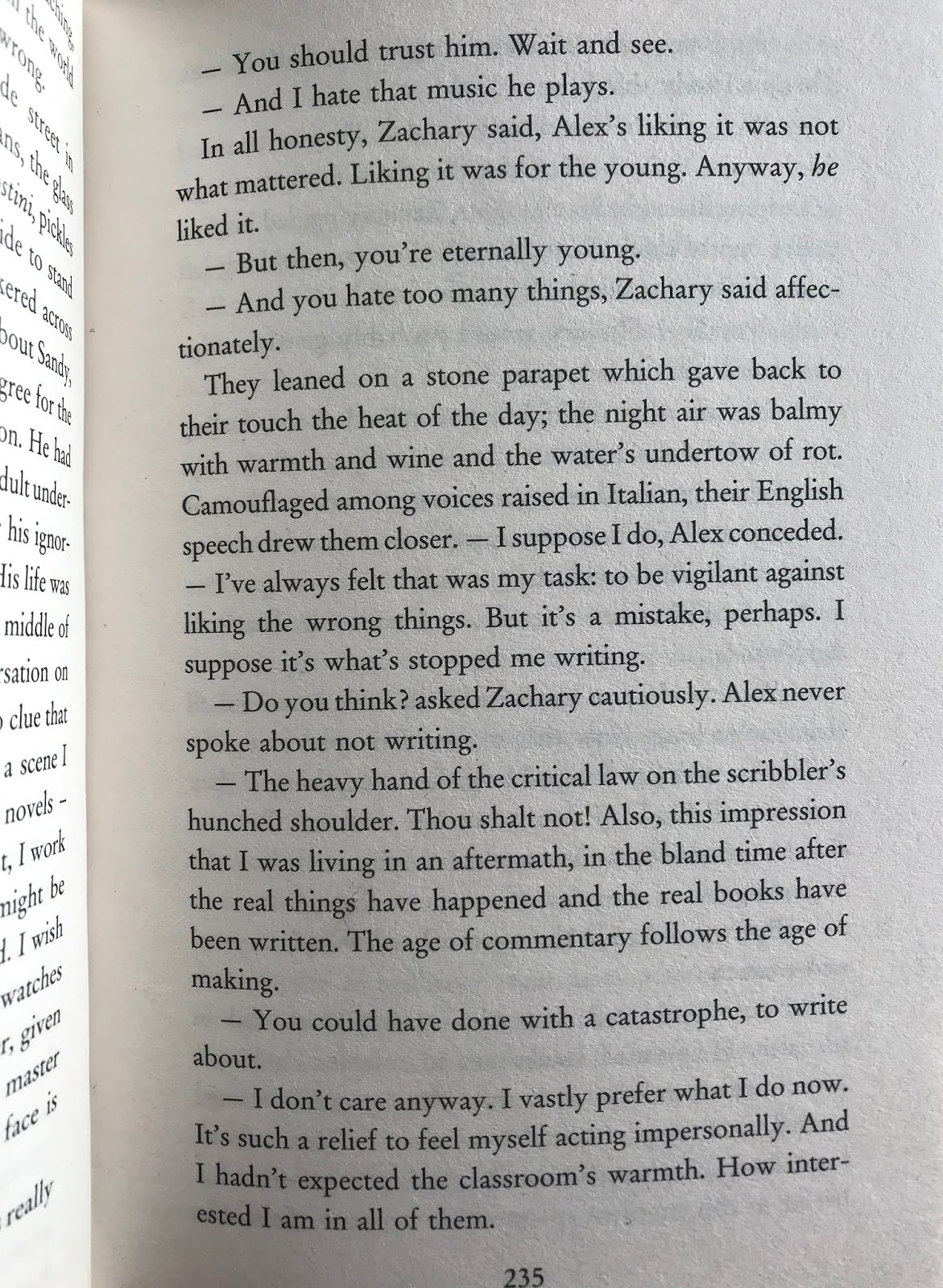
It also fleshes out issues around nostalgia and the way things were, modern vs. postmodern, action vs. reaction, creation vs. critique. The following passage beautifully articulates certain conundrums around writing today and how a writer is to follow 20th century literature, and the struggle to be original, pertinent, even revolutionary. 


Perhaps this is my own projective reading, but I wondered if the novel plays homage to a favourite book of mine, Milan Kundera's The Unbearable Lightness of Being, which also centres around four characters and their intertwined lives/interactions. In Late in the Day, Alex, one of the protagonists, moved to the UK as a boy leaving their home in Czechoslovakia. Alex's father is a successful writer, and presents for Alex an antagonistic figure in relation to his own (and subsequent abandonment of) writing. To complicate the relationship further, Alex's father, called Tomas, is a chronic adulterer, just like Kundera's Tomas, and eventually like Alex himself. Alex abandons his writing to become a primary school teacher, and is felt by himself and his friends to have chosen a career beneath his potential. In The Unbearable Lightness of Being, Tomas loses his ability to continue his medial practice as a surgeon and takes work as a window cleaner. 

Simply 10/10 from me. 

Wednesday, 24 June 2020

Chroma, John Divola

Recent interview of John Divola with David Campany in conjunction with the recent publication of JOHN DIVOLA: CHROMA. Photographs from the 1980s.

John Divola: "around 1980 I started a body of work about things you can’t photograph: Gravity, Magnetism, which way water drains, and the things I see when I press my eyes with the palms of my hands. All of these images required the construction of some kind of visual metaphor. One diptych was about temperature. There were two images, one with a fan blowing over a block of ice, which should be cool, and another with an electric heater with a block of ice, which would be neutral. So, for those images I decided to use colored gels. The fan and ice used a blue gel to represent cool while the electric heater and ice was magenta (which is red and blue) since it was both warm and cold."


JD: "Also, I was interested in the anthropomorphic impulse to read into the faces of animals and people. And finally, I have always been interested in the manner in which photographs operate in relation to abstraction and specificity. When you photograph a goat, especially if it is colored red, it is an emblem of ‘goatness’ – whatever you want that to be, evil, pastoral, a logo for cheese. However, photographs have a countervailing inertia in relation to the abstract since they are equally specific."


Citizens of Everywhere: Shami Chakrabarti, Tom McCarthy, Eloise Todd and Lauren Elkin

Yesterday I listened to a recording of a discussion hosted by the London Review of Books back in 2017 in the aftermath of Brexit called Citizens of Everywhere: Shami Chakrabarti, Tom McCarthy, Eloise Todd and Lauren Elkin, using the University of Liverpool project, Citizens of Everywhere as a springboard for discussion.

The title gets its name from a speech by Theresa May in which she said: “if you believe you’re a citizen of the world, you’re a citizen of nowhere. You don’t understand what the very word ‘citizenship’ means.”

In the LRB discussion, I was particularly intrigued by Tom McCarthy's link to Aeschylus’s Oresteia which he has articulated in an article in the Guardian called Does Theresa May really know what citizenship means?


While the talk and article are 3 years old and centred around the immediate responses to Brexit, I found them to be still of considerable value. McCarthy discusses the Oresteia as reflecting he choice of democracy over tyranny and learning to listen to the dialogues of those we disagree with: Athena defers the opportunity of making a unilateral decision by calling upon the 12 wisest citizens to debate the issue at hand and reach a consensus. The point ultimately is that democracy is a structure that allows debate and enables voices and disagreement and that it has the capacity to endure and contain disagreement in the form of dialogue.

The presence of such a structure that exists within a polis (city), is what allows difference to co-exist. To advocate for democracy then is to consent to and approve of a nation that encourages the presence of difference and different views expressed through dialogue. For it is the bearability of disagreement and the survival despite it that enables the existence and maintenance of a democratic nation.

McCarthy writes: "one is a citizen not simply because of an internal relation to one’s community, although that’s part of the picture, but because of a relation to a complex, often troubled outside; through the acceptance of the outsider into your place and yourself into theirs... It turns out that May is not just wrong; she’s exactly wrong. If you’re not a citizen of the world you’re not a citizen of anywhere. You’re not even a citizen; you’re just a subject."

Wednesday, 10 June 2020

LRB Screen at Home: Kevin Barry on ‘Tim Robinson: Connemara’


Was great to reconnect with literary events again this evening listening to Kevin Barry discuss his work and writing process as well as Pat Collins's film ‘Tim Robinson: Connemara’ on Robinson's journey as a writer and cartographer mapping out Connemara.

(Film still)

Some notes from the talk:

- Happy/sad fields - a concept by philosopher John Moriarty
- How a place exudes a feeling that effects us
- How our surroundings and sounds places effect our moods and temperament and how our characters are formed by our landscape
- Isolation and remoteness and what we discover when we go out on our own
- How coronavirus has made us observe our surroundings
- Focus as making us more aware of place and the subtleties of our locations - paying attention to things we didn't previously
- When you think about place you have to think about time. The patience involved in certain projects that carefully attend to place
- Writing a novel over the course of a few years makes it very challenging to achieve a coherent voice as over that time, the author is changing consistently