Showing posts with label Book thoughts. Show all posts

Wednesday, 12 March 2025

Shon Faye, Love in Exile

I really loved Shon Faye's non-fiction book of personal essays on love and explorations of different kinds of love beyond romantic love. I found compelling her arguments around how the fetishisation of the nuclear family and heterosexual romantic love and 'failure' to find this as not evidence a personal or intrinsic shortcoming, but as markers of a failure of society. 


Depictions of heterosexual love and partnership have been (falsely) elevated to the highest judgment of one's worthiness in books, films and television. Faye proposes that not only have these illustrations in media set unrealistic and unhelpful expectations, but that this obsession with securing romantic love is indeed a byproduct of late stage capitalism where the nuclear family and romantic love have served as a refuge and space of leisure away from the grind of work and productivity that exhausts and alienates us. Love has become more private as a result, and has shifted away from community oriented environments where different and more diverse loves previously flourished - for example, love in lasting friendships, which has been devalued in favour of a laser focus on finding and keeping romantic love, and nurturing this love in the confines of the private domestic sphere. 

I wanted to save the following page for two reasons: (1) because of its acknowledgement of the "crisis in male friendship" that has led to a rise in misogynistic views and violence against women, and (2) because of Faye's inclusion of the quote by Jo Spence, one of my favourite artists on the importance of female friendships. For Spence, it may have been "too late to be [her] mother's friend" but for many of us, the opportunity remains not only to be our mother's friend, but also that of our daughter's and to impart new teachings on ways to love. 

Monday, 9 December 2024

Vigdis Hjorth, Is Mother Dead

Rare that I take a photo of three different pages to return to. This book was brilliant, acutely well observed, raw and daringly complex. 

Is Mother Dead is an obsessive study of a daughter's efforts to comprehend why she is the way she is and where she comes from - how understanding and forgiving one's mother (for her rage and her suffering) seems crucial to understanding and accepting oneself, and what a daughter is to do if she not only does not have the privilege of having her questions answered and of reciprocated desire for contact, but also must contend with her mother's unequivocal rejection. 

Hjorth explores protagonist Johanna's reckoning of her mother's refusal of conversation and disinterest in collective healing and the ways in which Johanna resists this, inventing her mother in her mind, tracing her daily steps and routine, supposing her thoughts, feelings and hurt until this imagined mother becomes insufficient and unsatisfying. Instead, Johanna begins to stalk her mother's movements, eroding the boundaries and privacy long established to keep their lives separate. 


Saturday, 23 November 2024

Esther Kinsky, Seeing Further

Attending the book launch for Esther Kinsky in conversation with Daisy Hildyard a few weeks ago at Juno Books, and going to the pub with Esther afterward was very special, especially on Shabbat where greetings were exchanged in recognition of common heritage. Esther spoke much about her time living in Hungary and her efforts to rehabilitate an old cinema in a small, otherwise forgotten village. She also mused about the magic of the cinema in so poetic a manner so as to tempt me to run to the big screen following the event and immerse myself in the collective viewing experience, popcorn in lap, the warm bodies of others palpable. 


In the following passage, Esther laments the changes to viewing and how we see in today's digital world - the viewing of films less an event for community congregation and collective viewing or looking in the shared cinema, replaced by an increasingly privatised viewing experience, not only from our own homes but also, at times from our own individual screens. Moreover, the on-demand experience of private, at-home viewing means the viewer is always the selector, which deprives her of the discovery of someone else's programming, of being moved by another's choice. 


I recalled my years in cegep, the college building located right beside a cinema, and my frequent solo trips to see a film in between classes, alone but together with others who shared my city. Somehow even 2009 feels like quite a different time. 


Sunday, 29 September 2024

Natsuko Imamura, Asa: The Girl Who Turned into a Pair of Chopsticks

Imamura's book is comprised of three short stories each that blur the outlines of what we think we know to be the human experience and what it means to be live and survive. The body morphs into non-human form, yet consciousness, sentiment and attachment remains. The goal of life to endure is challenged at its very core. Abjection is peppered throughout Imamura's stories: her protagonists—grimy, mouldy, dirty, stinky—and their transformations sit outside society and what we take to be normal, and evade not only what is acceptable but also what is possible. 


In this opening passage of the afterword, Murata describes the strange, but also the unnamed/unnamable experience of life, our bodies and our environment that happens outside or beyond language and words we can have available to us to describe them. 

Monday, 17 June 2024

Sheila Heti, Motherhood

When I borrow books from my father, I inevitably have to contend with his notes and underlining and navigate which passages resonate with me because of my own reading, or because he has marked them before me - a fitting comtemplation given the themes of Heti's incredible book, Motherhood, and how imperative it is for the narrator/Heti to establish her own importance, purpose, desires, legacy. 


This passage resonated with my teenage self:


I loved this book - particularly how it holds nuance and conflict and allows multiple things to be true, including both ugly and tender thoughts about one's life and the lives of others. The narrator's internal dialogue (not monologue!) and questioning, the back and forth, the using of coin tosses to answer profound and consequential questions reminds me so much of conversations with female friends and the amount of analysis that goes into decisions and life changes as well as just the need to formulate one's own perspective and take, whether or not action ensues. 

I found the following passage provoking, especially the denoting of having children or becoming a mother as 'submitting to nature' and choosing not to as 'resisting nature'. My own version of this binary thinking takes the form of 'domestic' vs 'fiery' as they both apply to 'Jess' (always in third person) - my conclusions (if I could be said to have any) are merely that this is not made of simple stuff, and often we don't choose one or another but are always both, moving from one version to another throughout any period of time. 

Tuesday, 7 May 2024

Vigdis Hjorth, Will and Testament

Will and Testament is an extremely powerful book, packed with the messiness of emotion, trauma, memory and family dynamics - it holds nuance and contradiction brilliantly. 


I read this passage in a moment when I was thinking about influence and different paths that lead to different versions of yourself/your life:


Dealing with the aftermath and trauma of childhood sexual abuse, Hjorth makes use of Freudian proposals around exploring repressed memories and containing anger - she examines how people use extreme thinking and lies to justify their actions and render their enemy worse, all bad, to ensure a clear narrative of victim and aggressor. Interwoven with Freud's theories on repression and anger are conversations the protagonist has with a friend on war mentalities - specially in relation to Israel/Palestine. They discuss the slippery slope of abuse, where victim can become aggressor and use justifications for attacks - how victims inherit beliefs and narratives use them to justify self-defence or acts of aggression. 

What would it mean to end the cycle of violence and not to use the comfort of 'victim status' to perpetuate suffering? What might a person have to confront and absorb to ensure they don't become the next aggressor? What is the cost of this absorption and how can a person manage their self-destructive impulses to be freed by the truth, and healed by the recognition of others of this truth? What happens when you don't get the recognition from the people you want it from? 

The protagonist's friend describes his discomfort in Jerusalem and Tel Aviv which mirrors almost perfectly what I felt on my visit in 2018. In sum, the strange atmosphere where a modern and shiny city was built with walls that keep perceived threats or aggressors out - these walls hide the suffering of others and support those inside to try to forget what sits behind those walls and live under illusions of peace, kindness, happiness and fairness. To truly heal however is to acknowledge the blurred lines of victim/aggressor, not to conceal your aggressions behind sophisticated architecture and technology but to endure the ambiguity, acknowledge the suffering and manage this alongside the good without self-destructing acts or shame. 

Sunday, 31 March 2024

Marlen Haushofer, The Wall

The Wall was one of those novels that is at times rather boring, but also deeply fascinating and moving at the same time. Written in 1963, Marlen Haushofer tells the story of a woman with grown children and no husband who visits her cousin Luisa and her husband Hugo in the Austrian mountains when an invisible wall erects overnight whilst the couple are in town, leaving the 40-something year old protagonist as the last human on Earth (to the best of her knowledge). The narrator can see through the wall and identify that everything living has become petrified, people and animals suspended mid-action, but very much dead. Set with the spectre of nuclear war in the background, and the hypothesis that the wall may be an enemy attack, the woman makes the decision to survive. 

The novel is full of details of how she approaches her survival in the most practical senses: how she hunts, forages and plants food to keep herself nourished, how she weathers the elements and changing seasons, the small shifts in climate, the detail of the flora around around her; however, the narrative is centred around her dependency on the animals that she cares for and the role assigns herself to work for them as her primary impetus to stay and keep alive. 

The Wall takes the form of a report the woman is writing on her time after the wall has come up - we are told it has been over two years. The protagonist details her account of endurance, her deep loneliness and depression but also the love and companionship that fuels her will to continue, found in the friendship of the huntsman's left behind dog Lynx, a number of cats who are born and die throughout the story, Bella a pregnant cow who yields milk vital to the survival of the cohort, and eventually Bull, Bella's calf. Working with scarce resources, the woman feels responsible for the survival of her eclectic clan of pets, and with this purpose, industriously develops the skills and solutions to find a way to exist in her new ecosystem. 

Dependent on the meaning that this labour gives her, she hunts deer she'd rather not kill and seasonally moves from a hunting lodge in a valley to another property, and describes feeling split off as if into two different people who occupy two different places. This brilliant passage in an example of her psychic navigation of what it means to be in this place and her role in it - how she should neither get lost in fantasies of megalomania nor under state her environmental interventions: 

In her report, she remembers her previous life as a mother as if that person person too is a separate entity, and feels disdain to her grown children, who stopped needing her in the ways she needed to feel needed. With this role given new life through her animals, the company of whom she has come to prefer over that of humans, she reflects how her happiness in early family life with small children faded as they grew older, leaving her insecure and considerably less happy so much so that she writes, "Later on I had never been happy again. Everything changed in a wretched way, and I stopped really living". I found the confessions of anxiety that harm or death would come to her animals extremely moving. Deeply resonant was her acknowledgement that the creatures were wild and needed their freedom even if it meant they would be killed by predatory animals or disappear without explanation. A truth she accepted both in thought and action, her worst terrors were letting them out into the world without supervision, for fear of crisis, separation, loss, her own resulting loneliness and ultimately, the removal of her strongest survival mechanism. 

The book is at once the triumph of physical strength of a woman who decides she needs no other humans (indeed this comes to a head at the end of the novel), and endures an unforgiving wilderness and also a story of the dependency of the will and drive of women to care for and mother others, who find purpose and loss in this mothering. There is a tender moment where Haushofer describes an exchange of mutual mothering: the protagonist continues to stay alive to keep her cow Bella alive and knows that without Bella's milk, she and the others would all starve. In this moment of feeding, Bella is the great mother, in other moments, she is referred to as the protagonist's sister. Acknowledging the interdependency, in this passage the protagonist hopes that Bella dies before her, which would mean an easier death for her beloved cow and the opting into greater suffering for herself instead:

Sunday, 3 March 2024

Makenna Goodman, The Shame

It doesn't happen often, but sometimes a book comes to you at just the right time, when you didn't know you needed it most. 

Makenna Goodman's superbly written The Shame was one such story. This novel pierced me and recognised me and this current moment to an uncanny degree that my image of the protagonist Alma's Vermont house and garden merged with the very new, real experience of moving into my new house in and having a garden of my own for the very first time. 

The feeling that a book could have been written with you and your history in mind is curious. The sense of seeing and knowing you get from a person you don't know but who speaks (to you? to a group of yous? to a person they imagined could be like you or completely different from you?) from text on a page is, in rare but precious instances, like magic, a challenge to the time space continuum as well as to the idea that you are individual, unique, in a manner both humbling and disarming.  


Sunday, 31 December 2023

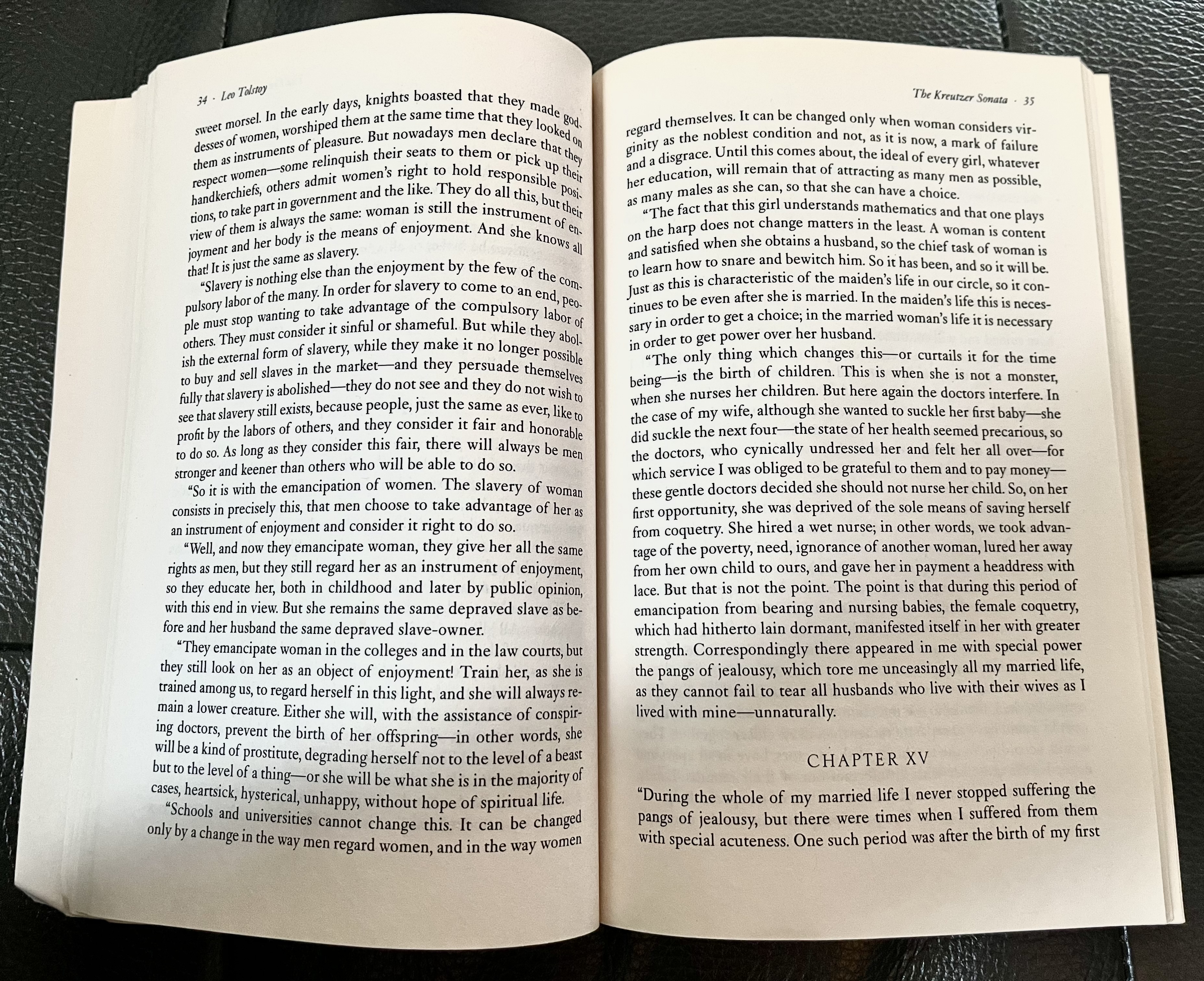
Leo Tolstoy, The Kreutzer Sonata


Really fascinating novella that exposes Tolstoy’s conflicted feelings about the dangers of love and marriage. For every “progressive” insight into the emotions stirred up by love (lust, jealousy, possession, oppressive monogamy), comes a set of propositions that sex and love are dangerous and only a life of celibacy can ensure murderous rage and immoral acts are dodged. Tolstoy’s fear of marriage and sex (and his insistence that women do not enjoy sex and are thus degraded by having to succumb to the carnal needs of men) is further illustrated in his manifesto-like sequel that follows the main narrative. 

An example: 


Doris Lessing’s preface is also highly entertaining wherein she chronicles a speculative comedic, clumsy, and messy (breast milk) sex scene in the Tolstoy household between the author and his wife, hypothesises that perhaps Tolstoy was bad in bed. 


Saturday, 23 December 2023

Daisy Lafage, Lovebug


Daisy Lafarge’s Lovebug is an extremely impressive and complex exploration of pathogens and takes a semiotic, psychoanalytic lens to look at how we could come to view and experience microbial life (pathogens, bacteria, viruses, bugs) as not the “bad” to a “good” counterpart (human, love) but to see both - that is, love and bugs - as made of the same stuff. 

Lovebug draws heavily upon epidemiology and microbiology and using language and poetics as a tool to disassemble assumptions and instincts. Lafarge proposes a more harmonious coexistence, one informed by a Kleinian depressive position (as opposed to a paranoid one) whereby we learn to live and cope with/endure ambivalence and think differently about how we fear or respond to the abject other not as a threat but as something likened to us. Sutured throughout this book are themes of merging/splitting, mirroring, attachment, love, hate, terror, rejection, consumption, violence, sex, illness, death, cannibalism, inside/outside, self/other, metaphor and materiality. Definitely a book to read, enjoy and think about again, and then again. 

Wednesday, 20 December 2023

Amy Key, Arrangements in Blue

A few weeks ago I read Amy Key's deeply personal book Arrangements in Blue where she shares her experience of living without romantic love, which is she deeply wants but also feels conflicted about insofar as she does not want to be defined by its absence. It is clear that Key's life is rich with friendship and all kinds of love, not least the love she has for and receives from her two cats. 

Key's book is extremely honest and vulnerable, deeply moving and relatable – it is also absolutely fearless and articulates those dark corners of our minds where ugly thoughts appear, those thoughts that trigger the protective instinct to hide them from others, especially those we love the most. Her reflections on motherhood (and the becoming mothers of those around her) and her experience of deciding she wants to be a mother and then finding herself no longer pursuing the steps that she would need to take to get her there reflected a lot of conversations I've been having with close friends lately about life stages, presences/absences of a partner and a desire to have children.


I loved the duality and multiplicity of this book and its unwillingness to shy away from complicated, simultaneous urges and emotions. Key proposes an alternative approach to these feelings (love, hate, friendship, jealousy, envy, appreciation, care, resentment, obsession, disgust, generosity, possessiveness, etc), which more often than not, fight against one another. Instead, in her radical candour, Key not only admits the concurrence of these conflicting feelings, but through her writing and emotional work, finds a way to allow and accept their coexistence, a process that I think brings one closer to a more authentic experience of oneself and others, opening a space to love more immensely and truly. 

Woven into the book's chapters is Key's love for and mis/interpretation of Joni Mitchell's album Blue (a personal favourite of mine) and how she has for decades relied on this album not only for companionship, but also as a place onto which she could project her emotions and experiences. 

Sunday, 1 October 2023

Don DeLillo, White Noise (1985)

White Noise is probably one of the best novels I've ever read - equal parts funny and touching, the narrative centres around how one builds and survives a life around establishing robust and ideally impermeable defences against fear of death. For married couple Jack and Babette, even the knowledge or acknowledgement of death complicates happiness and contentedness and a clear road to carry on. Through conversation between family members and academic colleagues, questions are raised about health, death, the meaning of life, like: is it more natural and/or healthy to repress emotions or to reveal your unconscious to yourself and others? what sets humans apart from other animals and can we be reduced to and/or escape 'male, homicidal, rage'? is the denial of death unnatural and are humans unnatural such that the construction and shape of modern life by definition goes against our animal nature? is death unnatural?

DeLillo's protagonist Jack (an academic who invented and is the leading scholar of Hitler studies) finds himself in an existential predicament when his fourth wife Babette, with whom he fell in love because of his perceived sense of her simplicity, practicality and joie de vivre, confesses to him that she has sought out an unapproved medication and has consented to testing it on herself outside the walls and regulations of a clinical trial - the purpose of this medication is to cure the patient of their dread and fear of death. Discovering this shared fear, Babette is no longer a safe and ample bosom for Jack to insert his anxious head into and he has to confront that this news directly challenges the reasons he chose Babette and his ongoing need for her to be the distraction and counterpoint to his anguish. 

Andreas Gursky, 99-Cent-II-Diptychon (2001)

This need for distraction is mirrored by the commercial inserts throughout the novel that interrupt scenes - voices appear from the radio, television, overhead speaker at the supermarket and eventually from no identifiable diegetic source such that the voices exist on the same playing field as the story itself. There is a clear comment on how consumerism and certain kinds of passive TV viewing behave as distractions against death, but also as a distancing of the real stuff of life so that humans are not rendered crippled and immobile from fear. Jack's compulsion for Babette to adhere to the tight constraints and boundaries he has established for her (that is, the Babette of Jack's mind) is repeated at the end of the novel where Jack discovers that this community of old German nuns are not believers, but indeed are committed to an act of service to the community in the form of an ongoing performance of faith to enable non-believers to continue to depend on the conviction of believers to find comfort in the concept/acceptance of death and the afterlife. What is a desperate Jack to do when these projected images of external figures rebel from the role he has allocated them? Certainly for him, a problem shared is not a problem halved, but one multiplied so infinitely to the point of eruption and violence. 

Toward the end of the novel, there is a great scholarly dialogue between Jack and his colleague Murray that theorises that there are two types of people: diers and killers. In order to escape being a dier, one could choose to be a killer and gain 'life credits' by way of asserting power and taking control. And yet, they reach the conclusion that despite all efforts to eradicate fear of death, death adapts and adjusts and cannot be evaded. 

Thursday, 21 September 2023

Muriel Rukeyser, Savage Coast

Savage Coast is a posthumously published, largely unedited, coming-of-age autobiographical novel that chronicles Rukeyser's experience as a young reporter traveling to Barcelona at the onset of the Spanish Civil War to cover the The People's Olympiad in protest of the Berlin Olympics in Nazi Germany, 1936. 


While my summer in Madrid at the age of 19 was of course nothing like Rukeyser's experience of what it means to be a foreign national in a country at war, confronting questions of neutrality and alignment, political and personal solidarity, the observations and transformation of Helen, Rukeyser's naive but insightful, deep-feeling protagonist, and her amazement while discovering Spain and herself in a country other than her own, was warmly resonant. 

The passage in the below image starts with: It was all new and must be important, must be valuable, in the same way that she used to think she must grow to be valuable. It was too much to carry, all this self-consciousness, and it was beginning to relax from her in the heat and adventure here.

It follows:


For good measure, because I saw and fell in love with this painting at 19: 

Saturday, 2 September 2023

Isaac Bashevis Singer, The Magician of Lublin

I picked up this novel as I've become interested in learning more about Jewish mysticism, specifically after discovering the dybbuk, a ghost/spirit of a dead person that is typically malicious and haunts the living by possessing them - sometimes it is thought that the dybbuk, male, would seek to possess women sexually on their wedding nights by entering through their vagina, an act that would require exorcism. The dybbuk that haunts Yasha, Singer's protagonist in The Magician of Lublin, is not sexualised, but takes the form of an evil spirit or monster that Yasha has been aware of and feared since childhood, a demonic spectre that creeps up and threatens his wellbeing and safety at regular intervals. 


The more I read the novel, the more I liked it and came to appreciate Singer's project - Yasha, who is half-Jewish and half Gentile is a magician from Lublin who travels across Poland, performing and gaining small celebrity status, though none equal to what he could accomplish if he were working in Western Europe. He has several mistresses in different cities and continuously contemplates leaving his wife Esther—a seamstress who keeps a Jewish home in Lublin and whom he only sees on the holidays when he returns—as well as each of his mistresses, wavering between total abandonment and radical commitment which would mean swearing off his wife and other lovers and in the case of Emilia, a Catholic, his Jewish faith. 

The Magician of Lublin reminded me of Dostoyevsky's Crime and Punishment as well as Camus's L'Étranger - the catalyst for Yasha's existential rumination swelling to spiritual crisis is a failed robbery of an innocent man. His impotence to pick the lock that would have yielded his treasure when lock picking had been one of his most revered tricks (indeed he does so hubristically with blindfolds in the first half of the book), causes him to reconsider what he thought he knew of himself and severely injuring his foot from falling from a window, renders him disabled, unable to go through with the (impossible, suicidal) tightrope performance, which he had been due to enact that week. One might even be tempted to think the robbery an unconscious act of self-preservation. 


Marc Chagall, The Juggler (1943)

Yasha, who is easily distracted and very impressionable, oscillates between extreme positions that he feels with such conviction in any given moment depending on the setting (Do I leave Esther? Magda? Emilia? Does religion mean anything? Am I a Jew, like those praying men in shawls and with teffilfin in this synagogue in which I too take refuge?), and finds himself confronting his own morality and existence, seeking spiritual signs of good and evil, sin/condemnation, piety/redemption. In the end, his Judaism becomes his salvation but not at the expense of his freedom. Grief and guilt stricken at the pain and death he has caused (Magda, is lover and assistant hangs herself as a result of his infidelity and fear of his abandonment), Yasha builds a tiny brick house behind his house with Esther to spend the rest of his days in prayer and shielded from the world to ensure he does not act on his temptations and has a small chance of obtaining Godly forgiveness. And yet, this physical isolation is not hermetically sealed solution - the townspeople of Lublin come to believe that he is a healer and saviour and visit him, pleading with him through a tiny window, with requests for blessings, such that he cannot live in total disconnection and humility, and without the projection and needs of others. His new fame results in journalistic coverage and reaching Emilia in Warsaw, the novel concludes with a most human letter from her on shared responsibility and alternatives to forgiveness and continuing to truly live after sin and with love. 

Saturday, 19 August 2023

Clarice Lispector, Água Viva (1973)

It took me a while to decide if I was enjoying Água Viva and until half way, I was ambivalent - the experience of reading it oscillates between poetry that you let wash over you and stream of consciousness, abstract storytelling. I wasn't sure if this stream of consciousness and free flow felt like you were reading someone's journal (with permission), if it was written for you, if you yourself are the journal inhabited. Some passages were extremely compelling and spoke right to me while others felt like unedited thoughts written in haste at once too private and personal while also too mundane to merit being shared outwardly.  

(I chose this photo because it reminds me of my maternal grandmother, but also how I imagine she could have been if she'd been different.)


Reading Água Viva didn't necessarily feel voyeuristic, only that at times it wasn't quite interesting or coherent enough to get invested and command your attention. In these moments, I questioned if it was a rather self-indulgent book, almost annoying, but then something in Lispector's prose creeped up on me and compelled me to keep reading. Sometimes these moments were the most pedestrian - finishing one section with something like I have to go now. and starting the next with I'm back. It was almost a 'stay tuned' moment, but one not meant for you as life had interrupted the line from writer to reader. I pictured and wondered where Lispector when in between those two paragraphs, what she'd encounter that wasn't written down, what had happened in the real world, a moment or time that I'd never be a part of? And so, I kept reading, sparks appearing just when I wondered what I was gaining - an interdependent dance of lull and pierce. 

There is something urgent about the book with its improvised progression, language funnelled through intuition to capture the present somehow, the instant. Lispector also reveals a great deal of fear and existential dread, and you feel she is trying to learn (anew? continuously?) how to be alive while fearing and trying to understand the meaning of death. 

A poignant passage:

“I’m sad. An uneasiness that comes because the ecstasy doesn’t fit into the life of the days. Sleep should follow the ecstasy to attenuate its vibration if echoing crystal. The ecstasy must be forgotten.”

Some more:


Saturday, 20 May 2023

Deborah Levy, August Blue

It was an immense treat and privilege to see Deborah Levy talk about her new novel August Blue a couple of weeks ago at Tobacco Factory. Being in her presence and witnessing her mind work in real time—the tangents she permits herself or doesn't know she's doing or perhaps she just accepts her flowing musings and does not try to stifle them—makes me feel like a teenager again, discovering my first favourite writers and certain 20th century novels. Milan Kundera and Gabriel Garcia Marquez come to mind. 


Deborah Levy's novels—and August Blue is no exception—are often journeys of the Europhile, and this love for countries in close proximity with diverse histories, cultures and language reflect the flanneuse pace of life, one which appeals tremendously but also feels somehow less and less possible as we plunge deeper in the 21st century, the world (technology and the possibility to be fully present somewhere and not know about elsewhere in real time) and politics (Brexit, etc) changed. 

Flanneuse living is also one of luxury and privilege and I suppose this hit me harder reading August Blue in a way that was more jarring than other instances of reading. Perhaps this is because I am close in age to the narrator-protagonist, Elsa M. Anderson, who is 34, and Deborah Levy, who is not 34, made her character in some ways seem not 34 either, perhaps by accident or perhaps intentionally – the novel explores the theme of the double so there are multiple instances of what I am what I am not what I may be. Yet, there was something of a 20th century and older voice in Elsa that didn't quite seem to fit. Sometimes this was in the quality of observations of those around her or of certain word choices ("cancelling" or "Queen") that disrupted my immersion. Perhaps I felt these not to be the thoughts or actions of someone my age – at one moment, without much thought, Elsa hands a 50 euro note alongside her wet bathing suit to a homeless man in Paris when she cannot find smaller change. 

The issue of money overtly hangs over the novel towards the end as her teacher/adoptive father Arthur Goldstein is on his death bed and questions of his estate are aired by his long term, but until recently, hidden lover. Less addressed is the monetary cost of the flanneuse lifestyle – while Elsa has royalties as part of her income and some savings, not working is, of course, not free and neither is travelling and living in multiple places, presumably paying simultaneous rents and/or for hotel rooms in London, Paris, and Athens, even if a couple nights of her accommodation is paid for by the parents of the students she gives two or three lessons to as part of her travels. And if for Elsa, it is affordable, and she can also make use of financial help from Arthur, then I suppose I am wondering about how, as a reader, taking in the extravagance, which is unrelatable and unachievable for most, made me feel. 

It is possible that this disruption for me comes from a place of envy as I find myself five years or so into full time employment since my PhD came to an end, and perhaps as a result of doing the PhD in the first place, my capacity to travel spontaneously was extended beyond what most people can hope to access. It has become evident since joining the world of work and indeed, like most, needing to work to live, that the capacity to live in multiple places and not work is not only impaired, but will continue become more and more challenging as more roots take firmer holds. For some people, this luxury has and will always be an impossibility. While it may be that Elsa's life does resemble how artists or child free or single people might live (or perhaps even retired people), especially those without a 9 to 5, there was something romantically 20th century about the leisurely city hopping and having no other place to be, that somehow feels of another moment (especially in the pandemic, when the novel is set). Spending time in the world of August Blue felt simultaneously indulgent and pleasurable, but also disconcerting – I suppose either way, this may be in line with the double, the being and feeling both at once. 

Monday, 20 March 2023

Olga Tokarczuk, Flights

I'm not too sure this book as a whole, which interweaves thematically related fragments—themes such as travel, nomadic living, flights (both in the sense of air travel and running away), bodies, dissection, anatomy—that transcend time/place/history/country is really coming together for me and I've had to put it down and pick it up, reading other books in between. Yet I have persisted as some passages are so astute and resonant, not to mention beautifully written. I like the book's corporeality and grotesqueness (I enjoy the visceral, eerie, female writing of Mariana Enríquez and Ottessa Moshfegh, whose characters also refuse to obey societal norms, who opt out or who subvert the social and expectations through obscene bodily expression) and Tokarczuk's musings on bodies and limbs whether dead, preserved or living.

The following passage comprises the translation of incoherent and unintelligible mutterings of an old, homeless woman living outside society, who wears layers of clothes and spends her time cursing passengers and passersby at an underground station in Moscow. 

A young mother with a chronically ill child and distant husband has relief from her household duties once a week when her mother-in-law visits and does crucial housekeeping and caring for the young boy. On one of these days off, the mother finds herself emotionally blocked up and unwilling to go home. Her attention is captured by the old woman (perhaps she sees something of herself in her) and the mother proceeds to spend her subsequent days riding the underground and finding somewhere warm to sleep like a boiler room, and unable to remember her family urgently enough to return to them. 

Sunday, 12 February 2023

Sigrid Nunez, What are you going through

I love Sigrid Nunez's voice - something adjacent to Deborah Levy and Rachel Cusk in terms of observer of others and of herself as she makes her way through different spaces and places. Nunez does not shy away from emotion, psychic contradiction and the unexpressable/unsayable - deeply moving and relatable. 

What are you going through (title taken from a Simone Weil essay where the original French is something quite different: Quel est ton tourment?) is a beautiful novel about friendship, love, aging, illness, loss, family, sanity and memory, agency and emotional expectation/defiance. Looking forward to reading more by Nunez. 

Saturday, 4 February 2023

Violaine Huisman, The Book of Mother

I adored this book, which was, in some ways, despite different lived experiences, very familiar to me. With such precision and shown through behaviour rather than description, Huisman narrates the relationship dynamics between family members and how we act according to what we need from our loved ones, including the need to confirm the narratives that keep us well and alive, whether un/reasonable, sane, destructive, passionate, excessive, violent, adoring. 


She captures the impossible task of a daughter to imagine the unknowns and unknowables of her mother's intimate thoughts, rationales and history, chronicling an imagined interiority governed by the earliest and most sticky of traumas that lead to obsessions around abandon, worthiness of love, health, wellness and pain, freedom and what we deserve or are owed to be free. Huisman's story interrogates the inheritance of our traumas by looking back across multiple generations: within her examination is the consistent tension between saving our forbears, idolising and worshipping them, holding them as ultimate judge of our goodness and accomplishments, with the need to separate from them, hate them, mould ourselves in contrast to or competition with them, needing them to die while also live indefinitely in order for us to persevere with recognisable definition and continuity. 

Friday, 13 January 2023

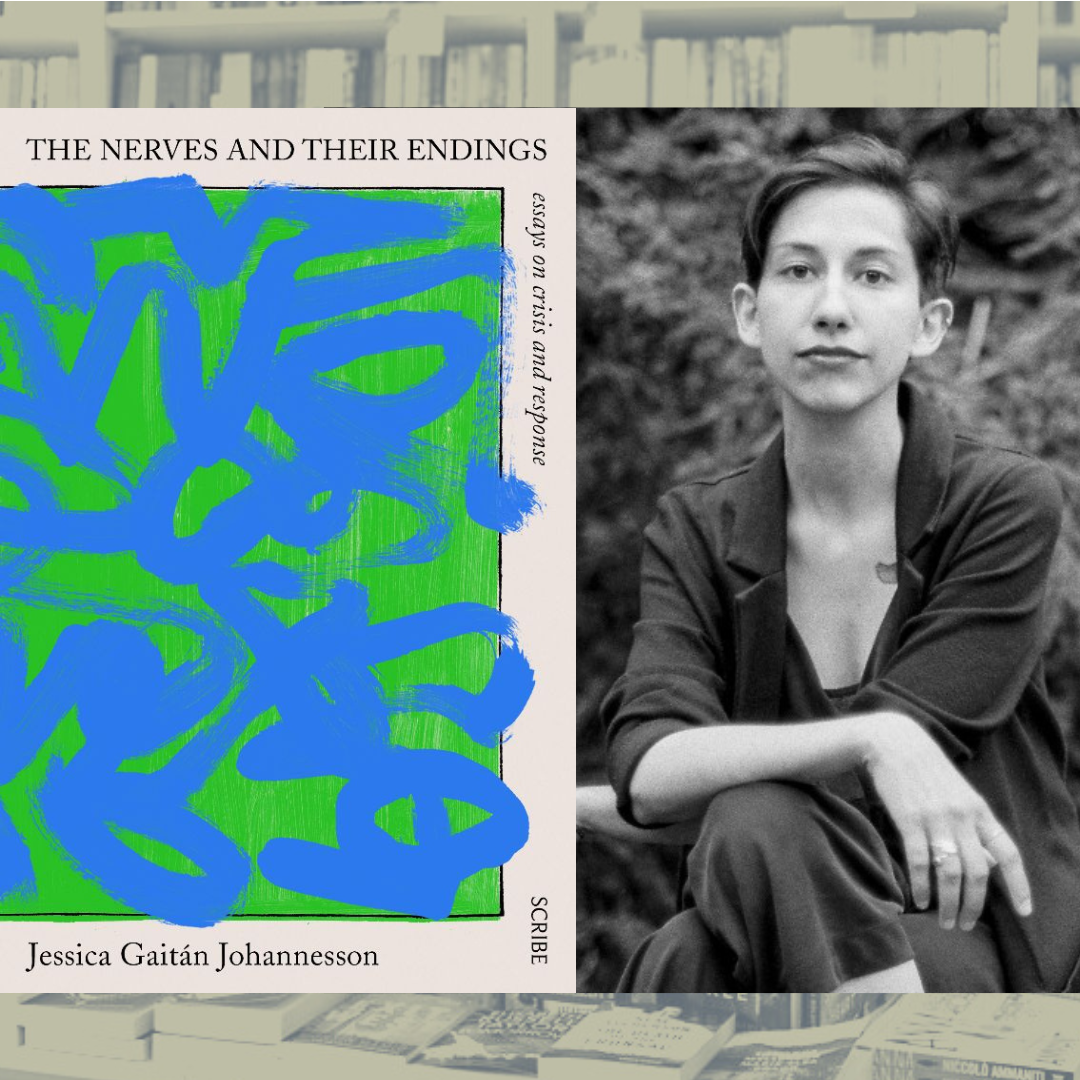
Jessica Gaitán Johannesson, The Nerves and their Endings

This remarkable collection of essays begins with an exploration of control and ends with one on hope, discussing so much in between: climate collapse, activism, eating disorders, identity (race, queerness, nationality), naturalising in the UK, capitalism and work, motherhood, illness and loss. Intersectionality is at the core Gaitán Johannesson bridging the personal and political as well as the relational and relative experiences of belonging or "unbelonging".


Linking climate anxiety and anorexia in the first essay, Gaitán Johannesson teases out the conflicting duality of wanting to control your self and surroundings—what you choose to eat or not, or your personal choices around living greener by, for example, choosing not to fly—and the recognition that so much is out of your control, that things happen to us without notice or invitation, that we are products of society, and that those with the greatest power to make the enormous changes are needed to safeguard the planet from further climate chaos and loss.

In one essay, Gaitán Johannesson interweaves moving and tender passages where she directly addresses a future and/or hypothetical child, while detailing her ambivalence and anxiety around having children given the projection of further, extreme climate collapse. Her arguments focus less around the carbon footprint of a child or overpopulation, which she presents as lacking in nuance—as carbon footprint is highest among the world's richest 10% and overpopulation has been used to justify racial violence and suppression—and distractions from the greater issues, which are, in short, late capitalism, endless production, extraction, and exploitation. Instead, Gaitán Johannesson's impulse is parental: to protect from suffering. That she would be unable to reassure her child that they would be safe and live a long and quality life is cause for distress and hesitation. Rather than present a judgmental position of right and wrong around having children in our times, Gaitán Johannesson acknowledges the personal and private stakes of this consideration, and that her alongside her anxiety and ambivalence—which she has made public, for better or for worse—is the recognition that this would entail a personal loss. 

The Nerves and their Endings was so relatable for me in so many ways (Gaitán Johannesson's narrative of becoming a British citizen could have been written as my own). I so valued the sensitivity but also anger, energy and frustration that came through in each of the essays, which reflect how emotionally complex it is to make our way through the world right now in a way that foregrounds care, compassion, courage and action.